Mesopotamia
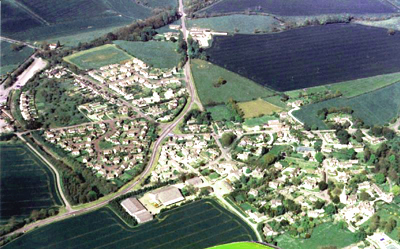
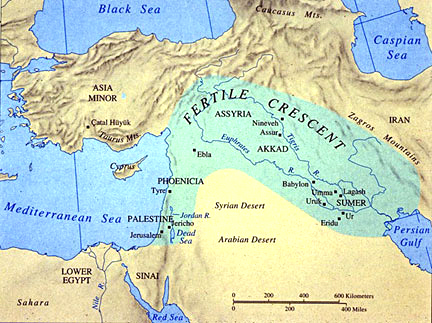
The first cities arose along the Tigris and Euphrates Rivers in Mesopotamia five thousand years ago. One impetus for such centers was the "storage and distribution of food,"(1) and its subsequent defense.(2) The growth of cities is studied along with the parallel growth of the agricultural revolution(3) - a revolution that would change the face of the world forever. Before great innovations in the field of agriculture, people moved across the land to hunt and collect food such as berries: "hunting and gathering required a minimum of two square miles of territory to produce the food for one person."(4) With the rise of agricultural practices, more and more food could be produced in a smaller area, enabling people to come together to form basic communities; the farmer could begin to feed more than his or her own family. For cities to form, "a fraction of the population first had to be freed from cultivation."(5)
From humble beginnings, cities of the world continued to grow until urbanization began threatening the very food supply that enabled its existence in the first place. Urban areas include not only the primary city, but also its suburbs and the sprawl that goes hand in hand with both. Urbanization is threatening our food supply in North America, along with other countries around the world. How has it come to this? Our civilization began in rural areas, in beautiful countrysides and in picturesque enclaves and river valleys scattered across the planet. What made cities grow to such size? And how is urbanization affecting prime agricultural areas in specific regions of California, British Columbia, and Ontario, Canada? What are the implications for us, if these trends continue at the present rate? What are the repercussions for Planet Earth, as we know it today?
The birth of scientific agriculture may have given cities their beginning, but it was the forces of industrialism that led them on the path towards great expansion.(6) It was the Industrial Revolution of the 19th century which caused cities to swell with people hoping to improve their economic position by leaving the fields and getting jobs in city factories.(7) Many of these urban areas grew up in the middle of prime agricultural land which is now lost forever.(8) Cities were in existence at the beginning of the 19th century, but "only two percent of the world population lived in them, and not more than fifty cities had populations exceeding one hundred thousand."(9) And, hand in hand with industrialism came employment opportunities on a large-scale. Millions displaced from farms because of the mechanization of agriculture, flooded into the cities. In 1800, only six percent of the American population lived in urban areas; by 1850, it had grown to fifteen percent. By 1900, forty percent of the population were living in the cities of America.(10)
As people poured into urban areas looking for work, it soon became apparent that there was a lack of adequate housing. Slums began to grow beyond city centers, on the periphery of urban areas, and spread like a cancer. As migration into cities continued, more and more factories were built and people were forced to live closer together for economic reasons. The growth trend which sees a population explode within a small area is called implosion by demographers, and this seems to characterize the phenomenon of the 1800s.
With the building of the manufacturing sector came the necessity of railroads, highways, and an expansion of the industrial base. In The World Cities, Peter Hall calls the:
Growth of white-collar occupations of all kinds without a doubt the most important single explanation for the growth of the world cities in the period since 1850. Also retail trade grew in most metropolitan cities faster than did the demand of the immediate population; for these centers provided a shop window for national and international markets. Certain types of manufacturing industry, women's fashions, men's tailoring, jewelry and precious metals, and high class furniture, were distinctively metropolitan trades. Such goods have to be made in close and immediate contact with the final purchaser and specifier.(11)
People went to the world's cities for a myriad of reasons, including employment, education, health care, higher quality public services, and the opportunity to earn higher wages.(12) Urban growth continued until the end of World War I when war production had begun to cause strains(13) in the very fabric of North American cities. Enormous numbers of workers were needed in wartime production on the home front, causing considerable pressure on cities' transportation systems and housing facilities.(14) The people who could afford to leave the cities did so at this time, giving birth to suburbs.(15) Many continued to leave throughout the 1920s and 30s as the Depression hit cities particularly hard.(16) This exodus exploded after World War II, and has been labeled deplosion by demographers.(17) The Depression was finally subsiding with help from the war-induced economic recovery, and millions of veterans returned with the ability to buy homes through financial incentives provided by veterans associations and government loans.(18)
Millions of people were able to buy houses instead of rent, and preferred new homes in the country where there was an abundance of land. They wanted white picket fences, instead of attached row housing in the decaying urban cores that cities were offering. Cities were too dirty and too crowded, and most wanted to own their own piece of land, however small it was. Communication systems had improved, government policy favoured home-ownership, and the wide-spread ownership of automobiles enabled families to move out of cities(19) and still commute to work, "making large-scale dispersion of populations feasible."(20) As a result, highways were needed, which caused great destruction to agricultural lands. Each kilometre of road or highway requires approximately 6.5 hectares.(21) Other prerequisites were airports, which take thousands of hectares of land for their construction, as well as garbage dumps and landfills that were often built on agricultural land. Garbage significantly contributes to the shrinkage in farmland. For example, Ontario loses 0.6 hectares of land to garbage everyday.(22)
The rapid growth of suburbs in North America can be seen as almost chaotic, with little planning and little servicing.(23) City dwellers looked at the flat, rich agricultural lands surrounding their cities and wondered how much it would cost to buy farmers out. As one farm fell to suburbia and then another, it was almost impossible for any of them to hang on, as suburbanites began to complain about the noise tractors were making and the smell emanating from the land and animals.(24) Farmers were offered substantial amounts of money for their land, and experienced incredible pressure from several special interest groups. Many felt they had no other choice but to sell out. Urban growth "removes hundreds of thousands of acres from production each year,"(25) not only in the United States and Canada, but in many fertile farm belts around the world.(26)
In the twentieth century, new industries joined old - industries that include information technology, telecommunications, and "custom-built electronic apparatus for scientific purposes."(27) Manufacturing businesses such as these must be positioned close to the consumer, and must therefore, be located in or near large cities. During the last few decades, another stage in the growth of urbanization can be seen. Since many city centers are no longer conducive for the development of industrial facilities, companies have moved out of cities. High rent, high crime rates, and urban core decay have also contributed to manufacturing operations putting down stakes on the periphery of metropolitan areas where lower rent and lower taxes help keep costs down and profits up.(28) This is especially true for companies like credit card merchants that don't need face to face contact to conduct business.
Revitalized downtown cores are home to national and international companies, which need contact with the public.(29) People in occupations such as corporate law can afford to live in the expensive condominiums and renovated homes found in the areas they work. This further contributes to the displacement of low and middle-income residents out to the fringe, "creating epic urban sprawl."(30) Almost all cities in the world exhibit outward growth, with peripheral areas demonstrating more rapid growth than the cities themselves. (31) This coupled with the population explosion of the twentieth century, marks a dangerous trend. Statistics show that nearly eighty percent of those living in the United States today live in urban areas.(32)
California is the most important agricultural state in America, and produces forty-two percent of the country's fruit, and forty-three percent of its vegetables.(33) California is important for the subsistence of Americans and for other countries, such as Canada. Why then, would Californians allow "acre after acre of California's orange and vegetable cropping areas be taken out of production every year in order to meet the water needs of thousands of people who, each year and in ever-increasing numbers, invade Los Angeles?"(34) This land should be protected and other ways found to solve their water supply problems.
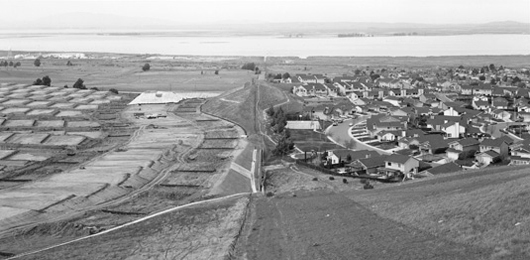
By 1960, already three million acres of high quality Californian farmland was lost to urban areas. (35) One third of the prime agricultural land was gone by 1980,(36) and predictions for the year 2020 show that more than fourteen million acres of the southern state's highest quality farmland will have disappeared.(37) In Environment and Man, Richard H. Wagner says that "the best farmland is not randomly distributed, and is often associated with cities."(38) Much of the agricultural land in California has already vanished beneath suburbs like Orange County in the Los Angeles Basin, and the Santa Clara Valley, south of San Francisco.
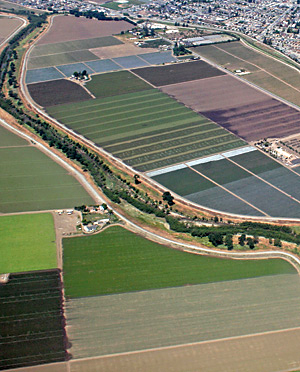
Seventy percent of the Santa Clara Valley was listed as prime agricultural land by 1949, but much of it is now lost to the San Francisco suburb of San Mateo. The people of San Mateo found the farmland very desirable for housing developments and offered farmers up to $15,000 an acre for their land.(39) Many found it difficult to resist the money, and who can blame them? If these trends continue, California will be unable to feed its own population, nor the rest of the United States and other parts of the world that rely on its produce.
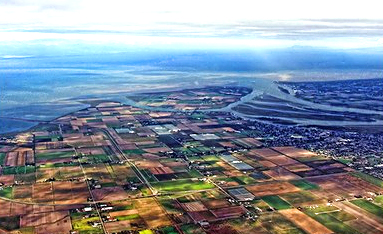
Although the United States and Canada have very different population numbers, and the "proportion of the population classified as urban is slightly higher in the United States,"(40) Canada has exhibited a very similar trend in metropolitan growth since the 1850s.(41) Suburban areas of Canada grew steadily since World War I and are continuing to display similar patterns, with urban populations almost doubling between 1951 and 1971.(42) In terms of population growth in Canada, there are some regional and provincial differences, but overall, the trend is similar to our southern neighbour's. An example is the city of Vancouver and its surrounding region. It has shown rapid growth in suburban developments and continuing urban sprawl.(43) Urban sprawl areas will eventually merge with a city just as Surrey's did in ten short years during the 1950s, becoming enmeshed with metropolitan Vancouver. (44) The lush Fraser River Delta system runs through the area and is home to sixty-five percent of the agricultural industry in British Columbia.
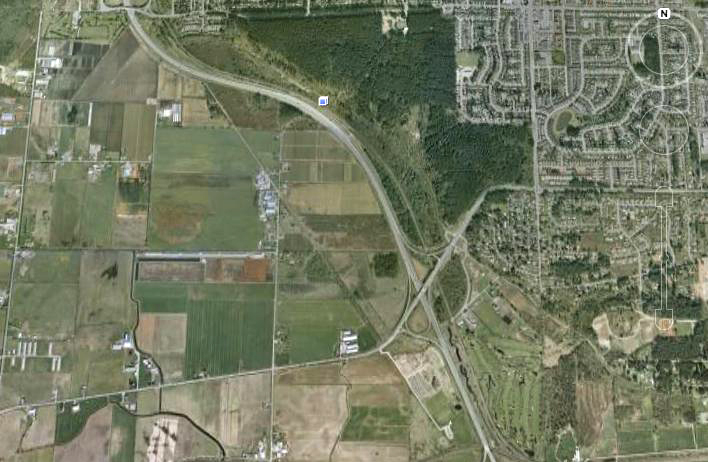
During the 1950s, Vancouver stretched in four main directions, with much of the land developed into single-family suburban housing tracts.(45) The loss of prime agricultural land in the Fraser Delta was quite high during this time, especially in the areas of Surrey, Richmond, and Delta.(46) The depletion of farmland can also be attributed to urban industrial growth, which embraces over ten thousand acres in the area of Vancouver along the Fraser River. (47) Also, the population explosion in the area, particularly in the last two decades, has put a lot of pressure on zoning regulations. So much prime land was lost along the delta that the province was forced to pass the Land Commissions Act of 1973, requiring the preservation of 77,165 acres of agricultural land within the Greater Vancouver area.(48)
Vancouver has been called the San Francisco of the North and has the second largest Chinatown in North America, after San Francisco. The 1997 deadline given by Communist China to regain control of Hong Kong caused a massive exodus to the Vancouver area. The immigrants brought a lot of their wealth with them and bought up as much real estate as they could. The real estate market exploded and the average price of homes increased at an alarming and rapid rate. The result was a second exodus: one which saw lower-and-middle income Vancourites fleeing the city to the suburbs and further.
Farms are still operating in Greater Vancouver, but many fewer than in the past. Some of the decrease in agriculture can be attributed to "absentee owners of 19,330 acres of traditional farmland."(49) What will happen to food production along the Fraser River Delta system is still unknown, and will, in part, depend on population levels in the area.
Many of the same trends can be seen across Ontario. Cities such as Ottawa have swallowed up huge tracts of farmland for their suburbs and urban sprawl. Ontario has some of the most prime agricultural land in Canada and exports help to feed the country from coast to coast; however, it is also one of the most urbanized and industrialized regions of the country with some of the highest population densities in Canada. The Niagara Fruit Belt of Ontario, lying between Niagara-on-the-Lake, St. Catharines, Lincoln, and Grimsley, is in serious trouble.(50)
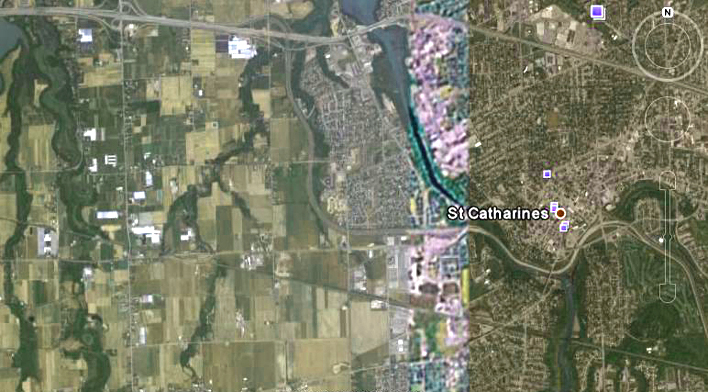
The area has been subjected to urban pressures associated with sprawl from St. Catharines and negatively affected by the number of cars, rapid post-war population increases, and newly built highways, all before the 1970s, when plans to prevent unregulated land use were implemented.(51) Farmers also contributed to the problem by selling off sections of their farms to housing developers for large sums of money. By "promoting urban sprawl in this way, farmers added to a further problem - the frequent incompatibility between urban and rural functions." (52) A bitter conflict arose between environmentalists and developers in the 1970s, which ended with the adoption of the 1981 Regional Niagara Policy Plan. The plan offered safeguards against future developments. (53) The judgements found in the document caused no repercussions during most of the 1980s, when population levels fell to an historical low, and recession caused a decline in manufacturing industries and housing developments all over Ontario.(54)
By the late 1980s, the economy began to show improvement, and people began to build homes again on the unique agricultural land of the Niagara Fruit Belt. The government tried making compromises in the region, but many of the farmers who suffered through the 1980s were in desperate financial straits and asked government for help. When little assistance was forthcoming, they thought it was their right to sell, especially given the great demand for land. Land was needed to expand the highway from Hamilton to Niagara Falls, and to accommodate new industrial parks and motels. But these urban pressures infringed upon a very important fruit and grape growing region of Canada.
Only two other areas in Canada can accommodate this type of agriculture: the Okanagan Valley of British Columbia and the Kent-Essex area of Southwest Ontario. Both are also high frost risk regions.(55) Permission was given for new houses, schools, golf courses, churches, retail developments, and warehouses to be built in the Fruit Belt. As Hugh Gayler pointed out in The Decline of the Niagara Fruit Belt: Policy Planning and Development Options in the 1990s, "the countryside is seen as the answer for cheap urban land."(56) But how much will it cost us in the future? High prices in Toronto forced people to look at the Niagara region for affordable housing, which will eventually make it an outer suburb of the big city. Pressures from urban centers all over Ontario are diminishing prime farmland needed to feed Canadians.
Many differences can be seen when you compare people in different countries, but one thing that is universal is our need to eat to sustain our lives. Without food, we can no longer exist. Lack of rainfall for crops, soil degradation, desertification, and soil salinity are factors that contribute to terrible physical hardships and famines around the world. We see these types of situations through the mass media and are concerned there are so many people with little or nothing to eat. All the while, we fail to realize that by allowing our cities to grow without interruption, we are literally and rapidly starving ourselves. Urbanization is threatening food supplies all across the planet.
The rapid loss of agricultural lands is prevalent throughout the world, and clearly shows that crops cannot compete with the sprawl characteristic of cities. Urban sprawl from different cities is beginning to overlap, forming megalopoli like the Boston-Washington corridor. We have reshaped our planet so drastically that most of us live far away from our source of food, allowing increased amounts of preservatives and pesticides to be used to allow products to travel over great distances. Urban centers have forgotten that their existence is totally dependent upon the rural areas that surround them. Instead, they have illusions of self-sufficiency. In reality, cities rely on faraway places for their food, fuel, and water, which often comes from distant reservoirs. The continued rise in population rates is also adversely affecting the carrying capacity of the planet, making aspects of food production much more worrisome and problematic.
Wasn't it Ghandi who said that we must be the change we wish to see in the world? It is up to each of us to realize that there are consequences to our decisions and actions - consequences for the future. We must be aware of them. Many people don't think about tomorrow or how they will feed their children. They are more interested in living life for the day, and seizing the moment. But what about tomorrow?
Related Papers
Tuvalu: Flooding, Global Warming, and Media Coverage