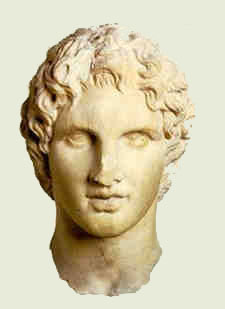
Alexander the Great
Our good life in Alexandria was brief, but how potent were the perfumes, how splendid the bed on which we lay, and to what sensual delights did we give our bodies to? - an Alexandrian poet
Today, Alexandria is the chief port and second largest city in Egypt with a population of over four million. It has a pleasant Mediterranean climate with sandy beaches, making it a favourite tourist attraction. Alexandria is the Egyptian Riviera, and is characteristically Egyptian with numerous mosques, palaces, monuments, parks, and gardens.
Egypt was invaded by the Arabs in 642 AD and became part of an expanding Islamic Empire. Since then, Islam has been the official religion of the country. The bulk of foreign trade passes through the port of Alexandria; excellent railroads and highways connect it to Cairo, the modern capital.(1)
Alexandria was an important city of the ancient world. For more than two thousand years, it was the largest city in Egypt and was its capital for almost half of that time. As an important trading post between Europe and Asia, it profited from the easy overland connection between the Mediterranean Sea and the Red Sea. During its three earliest centuries, it was perhaps the leading cultural center of the world, home to people of different religions and different philosophies. It was once the center of the Hellenistic Empire, and the hub of scholarship and commerce in the ancient world. Greek scholars, Roman emperors, Jewish leaders, fathers of the Christian Church, mathematicians, philosophers, scientists, poets, and other intellectuals flocked to Alexandria. One of the main attractions was the Alexandrian Library and Museum.
Alexandria was the intellectual capital of the world and famous for its extensive library, which in the 3rd century BC was said to contain 500,000 volumes. The Museum was a center of research, with laboratories and observatories, and had scholars such as Euclid and Eratosthenes working there. Alexandria was also a center for biblical studies. The chief librarian commissioned the Septuagint, which was the oldest Greek version of the Old Testament. Why did Alexandria become a destination for so many people of all races, creeds, and professions?
As Michael Wood said, "it was the first city of the civilized world in size, elegance, riches, and luxuries,"(2) where one could obtain anything imaginable to fill the needs of the body and soul. Just as its famous Pharos Lighthouse was a welcome sight for weary travelers, Alexandria acted as a beacon for merchants, curious tourists, religious prophets, and most importantly, the finest intellectual minds of the times. Alexander the Great had a dream as he slept one night,(3) a vision in which he learned the location for his new megalopolis,(4) a capital for his empire. The small fishing village of Rhacotis was where Alexander could see the possibility of humanity coming together - people living together with tolerance for one another's cultural and religious ideologies; living a life of freedom.
Plutarch tells us that Alexander went to Egypt and liberated the Egyptians from Persian rule, which they had suffered under since the 6th century BC occupation. When he freed the aristocracy, they welcomed him as their Pharaoh, a very great honour. They made him ruler of the oldest civilization in the world.(5)
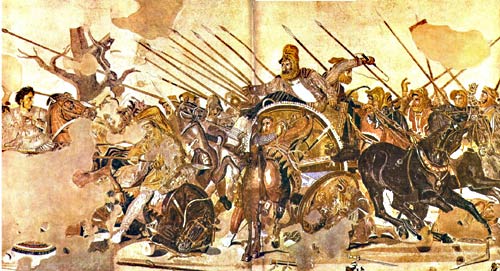
On his way to visit the temple of the god Amoun, Alexander stopped at Rhacotis on the Egyptian Mediterranean coast. He liked the climate and the coastal location, which also had a natural source of fresh water nearby. Its harbours were also an important part of why he chose that area of Egypt to become the capital of his empire. They were able to receive both passenger and commercial ships, and played a central role in the exporting of valuable goods, such as grain and papyrus. Alexander asked his engineers to plan a city in his name at the site. He also appointed Dinocrates of Rhodes to be his chief architect for the project. But Alexander did not live long enough to see his well-planned city reach its phenomenal heights. Ptolemy I, his trusted friend and general, took his corpse there "to set the seal on the new capital,"(6) insisting that Alexander would have wanted it that way. Ptolemy later had a mausoleum built in the city's center called the Sema, where Alexander's body was eventually placed in a golden sarcophagus.(7) By doing so, Ptolemy increased his own prestige, and also advanced his agenda to become Alexander's successor.
As time went on, many wars were fought amongst Alexander's generals, who were known as the Diodochi. After the Battle of Ipsus, it became evident that the great Hellenistic monarchs were destined to share in Alexander's conquests. Ptolemy's base was Egypt, and it was there that he and his descendants went on to build their capital into the greatest Greek colony of the ancient world. It was no longer the polis but the cosmopolis that epitomized the Hellenistic world. (8) The polis "was [now] simply a hometown, it was no longer the supreme norm of thought and culture."(9) This concept of cosmopolitan developed side-by-side with the Macedonian rulers. The world state, the mega-state, was proposed by them.(10) In the Hellenistic age, we get a sense of universalism in politics and a corresponding sense of individualism as the world expanded, and was linked by a common language (Greek koine). In Alexandria, there was a great fusing of many cultures; it was a great city built on the foundation of a tiny village to become the capital for the late great Alexander's empire.
Ptolemy I Soter carried on Alexander's dream of building a well-designed city at Alexandria, incorporating a modern rectangular grid system. The city's two principal streets may have intersected at the Sema and were said to be over one hundred feet wide,(11) and "paved with gold."(12)An area called Brokion was found in the center of Alexandria, and was the Ptolemies' Royal City that covered over a square mile.(13) Temples, theatres, palaces, administrative buildings, a coin mint, the King's residence, a zoo, and its famous Museum and Library were designed and built by the Ptolemies.(14) A great university grew up around the Museum and attracted many scholars, including Aristarchus of Samothrace, the collator of the Homeric texts; Euclid, the mathematician; and Herophilus, the anatomist, who founded a medical school in Alexandria. Much of the city was built out of exquisite stone. Where did all the wealth come from to build and protect such magnificence?
Ptolemy I was an intelligent man with good administrative skills. The excellent port and dock facilities were the foundation of all his prosperity, with two harbours capable of accommodating the largest ships of the day. (15) Egypt had enormous surpluses in grain that were exported all over the Mediterranean world, besides the valuable cash crop of papyrus that was used as a writing material. Gold mines were sprinkled between the Nile and the Red Sea coast, yielding large quantities of the precious metal. The gold was beaten into shape or cast in molds.(16) Exports were the foundation of wealth for the Ptolemaic or Lagid dynasty - Egyptian exports, as well as raw materials discovered in other parts of Africa. As Michael Grant said, "Alexandria made one set of fortunes by exporting ... and another by its maritime trading all over the near and Middle East." (17) Ptolemy was also a very experienced general. Since so much prosperity grew from his businesses, he was rich enough to have one of the finest mercenary armies of the time and a fleet that was hard to surpass. The army also kept a tight control on the Egyptian peasants,(18) who lived in grinding poverty and had very little to look forward to. Hellenistic monarchs like Ptolemy were very greedy and ruthless. They considered themselves great kings, even gods.
With the uncertainty of the time and the conflict that came with it, people began to look within themselves for peace of mind. The average male no longer had any say about political issues, nor could he be a soldier since mercenary armies were the norm in the Hellenistic World. Instead, he began to look at moral issues, and to the well-being of his soul. With traditional political religions no longer adequate, people turned to magic and mystery religions, with salvation or soteria, the object of their religious practises.(19) Thousands of papyri containing magical potions and spells have been found in Egypt. Reading the Pharmaceutria, an idyll by Theocritus, a belief in magical spells is easily seen:
Give me the bay-leaves, Thestylis, give me the charms
Put a circlet of fine red wool around the cup.
Hurry! I must work a spell to bind my lover.
O how he hurts me! Twelve days without a visit,
Without so much as a knock at my door to learn
If I were alive or dead. Does he care so little
Whose bed he shares? Is his love so slight? Tomorrow
I'll go down to the wrestling-school of Timagetus,
But now I'll bind him with magic. Moon, shine clearly
Listen to my song; I'll chant it low for you
And for blood-bathed Hecate, your earthly double,
From whom dogs cower as she wanders among graves
Be with me, Hecate, queen of terrors; help me
To make these drugs as strong as any brewed
By Circe, Medea, or yellow-haired Perimede.(20)
The Greeks who went to Alexandria were also very open-minded about the local gods, and a strange synthesis emerged in Greek Egypt. Ptolemy had even invented a new god named Serapis, who was a combination of the Egyptian god, Osiris and the Bull god, Apis. But the greatest Egyptian deity was Isis and her cult went far beyond the borders of the Land of the Nile, spreading throughout Europe. She was Osiris' mother and consort, the glory of women. In Hellenistic Alexandria, she became identified with Arsinoe II, wife of Ptolemy II, and with later Ptolemic queens. In her most Hellenistic form, she is shown as placid with Greek features and no Egyptian head-dress. Isis' iconography of Mother of all things became attached to the character of the Mother Mary, while the figure of Christ took over the figure of Osiris. The Hellenistic religions became the building blocks of Christianity.(21)
The Jewish community in Alexandria was large and had its own separate quarter in the city, overseen by an ethnarch. The Jews also had their own council under the Ptolemies. Around the time of Ptolemy II Philadelphus, the Alexandrian Jews began the translation of their Bible into Greek. This version is known as the Septuagint and was very important because it made the religion more accessible to many Jews who found reading the original difficult. The Septuagint also made Judaism accessible to people of other faiths, who were curious about the basis for the Jewish religion. (22) Greeks, Romans, and Jews constituted the majority of people living in Alexandria in its heyday, but there were also many thousands of Egyptians, Persians, Syrians, Moroccans, Turks, and many Asiatics.(23) Alexandria was a melting pot of people from all over the ancient world. The outcome of having so many cultural and religious ideologies coming together in the city was that Christianity was able to rise out of the Hellenistic movements of magic and superstition, philosophy, mystery religions, and Judaism. It was the Hellenized/Gentilized Jewish philosophy typified by St. Paul and Philo of Alexandria - the fusion of Jewish and Greek thought - that formed the basis of modern Christianity, through Clement and St. Augustine.(24) As Michael Wood observed during his visit to Alexandria:
Down here in the catacombs of Alexandria you can still enter that weird and wonderful world where Egyptian, Greek, Jewish, Oriental religions and magic met and intermingled ... One can see human figures in Ancient Egyptian poses with Greco-Roman faces ... guardian serpents carrying Hermes, the Greek guide of souls, with Medusa's head pictured above.(25)
People living in or visiting Alexandria during those early days felt they were living in Paradise. Many had come from small, rural areas and no longer had to be concerned with the political or military aspects of their poli. Life had opened up in a lot of ways for a Hellenistic kosmopolites in terms of how they lived, where they could travel, and the gods they worshipped. Alexandria was the first great city of its time and people from everywhere went there for their own personal reasons. It was a land of opportunity, where anything was possible: the best wine, the most pungent of spices, the finest clothing, wealth which could not be imagined, luxurious architecture, expensive foods, games, numerous theatres, and the most beautiful women in the world. One poet writes of two women discussing why one of their husbands has vanished. He had gone to Alexandria on business and after ten months had not yet returned home.(26) The attractions of the city were intoxicating and some did not want to leave; but it was also a very dangerous and unpredictable place. The city is described as bustling, crowded, and very rich. In Theocritus' idyll, The Festival of Adonis, Alexandria is said to be exhausting:
The people! The Chariots! Everywhere, men in cloaks and hobnailed boots. The road seems longer each time I call on you ... How shall we manage to find our way through this mob? ... Get off my feet, sir! I'm caught like you in the crowd.(27)
One can also read about a man who had killed a cat and before the day was over, was dead and his house burnt to the ground.(28) Law enforcement was often carried out by the mob, and in such cases, not even the king could change a person's fate. Cats were very sacred to Egyptians. Respect had to be shown to them or you suffered the consequences.
Against this backdrop of excitement and power, another sector of the ancient population arrived in the city: the scholarly and intellectual men, who found their places in Alexandria's famous Museum and Library, and who took advantage of the Ptolemic patronage that made their work possible. The top minds of the day could concentrate on their research without having to worry about going to war or how to feed themselves. Centers of cultural activities in the Hellenistic era no longer centered around Athens, but instead, could be found in the capital cities of the great Hellenistic kings. For Greeks, the center of the earth was no longer Delphi; the center had shifted dramatically. The Macedonians had a lust for culture, a lust that found its roots in the Greek perception that Macedonians were barbaric and stupid. Some Macedonians - surely the royal family - felt they were Greek and just as advanced. They now had the wealth to prove it. By possessing the written works of great intellectuals, they believed they could somehow possess the very souls of the creators. (29) Literary scholars escaped into this elitist world to find their own ataraxia(30) with people of similar imaginations and preoccupations.
There are so many questions to ask. Who were these special, gifted men, lucky enough to take part in this spiritual and scholarly fraternity? What was their legacy? What were the Museum and the Library of Alexandria?
Theophrastus, a student of Aristotle's, advised Ptolemy on the Library. The library of Aristotle actually provided the model for the Library of Alexandria.(31) Ancient geographer, Strabo tells us that Aristotle taught the kings of Egypt to establish a library:
From Scepsis came the Socratic philosophers Erastus and Coriscus and Neleus the son of Coriscus, this last a man who not only was a pupil of Aristotle and Theophrastus, but also inherited the library of Theophrastus, which included that of Aristotle. At any rate, Aristotle bequeathed his own library to Theophrastus, to whom he also left his school; and he is the first man, so far as I know, to have collected books and to have taught the kings in Egypt how to arrange a library. Theophrastus bequeathed it to Neleus; and Neleus took it to Scepsis and bequeathed it to his heirs, ordinary people, who kept the books locked up and not even carefully stored. But when they heard bow zealously the Attalic kings to whom the city was subject were searching for books to build up the library in Pergamum, they hid their books underground in a kind of trench. But much later, when the books had been damaged by moisture and moths, their descendants sold them to Apellicon of Teos for a large sum of money, both the books of Aristotle and those of Theophrastus. But Apellicon was a bibliophile rather than a philosopher; and therefore, seeking a restoration of the parts that had been eaten through, he made new copies of the text, filling up the gaps incorrectly, and published the books full of errors. The result was that the earlier school of Peripatetics who came after Theophrastus had no books at all, with the exception of only a few, mostly exoteric works, and were therefore able to philosophize about nothing in a practical way, but only to talk bombast about commonplace propositions, whereas the later school, from the time the books in question appeared, though better able to philosophize and Aristotelise, were forced to call most of their statements probabilities, because of the large number of errors. Rome also contributed much to this; for, immediately after the death of Apellicon, Sulla, who had captured Athens, carried off Apellicon's library to Rome, where Tyrannion the grammarian, who was fond of Aristotle, got it in his hands by paying court to the librarian, as did also certain booksellers who used bad copyists and would not collate the texts – a thing that also takes place in the case of the other books that are copied for selling, both here and at Alexandria.(32)
Strabo is referring to the Peripatetic influence on both the Library and Museum, "with emphasis on the collection and comparison of material, rather than on abstract philosophies in the tradition of the Academy."(33) The library was founded by Ptolemy I, but his contribution was overshadowed by the magnificence of his son, Philadelphus.(34)
The founding of the library in 295 BC can be looked on as the turning point in bibliography and book-keeping. The library became the center of Hellenistic literature and literary life. Many ancient texts still survive to this day because they were collected, preserved, and stored at the Library of Alexandria. The library had a mission to collect a copy of every single book ever written. They collected copies of classical writers, collated them, and came up with a text that was as close as they could get to the original material.(35) In the third book of Galen's Epidemics, he says that Ptolemy became so obsessed with the collection of books that he ordered any books found on ships docking in Alexandria confiscated and copied. The originals would be kept by him and the copies given to the owners. These books were subsequently labeled "from the ships."(36) Books were mostly purchased at huge book markets in places like Athens and Rhodes. Galen also tells the amusing anecdote of Ptolemy asking unsuspecting Athenians if he could borrow the original standardized texts of their tragedies by Sophocles, Euripides, and Aeschylus, so he could have them copied. Ptolemy was asked to put a deposit of fifteen talents on the transaction, which he willingly did. Ptolemy never did return the originals, but gave the Athenians back copies.(37) Fifteen talents was nothing to such a wealthy man; Ptolemy and his descendants were to spend much more attracting and keeping the scholars who graced the halls of their cultural establishments.
The monarchs wanted poets in their courts and libraries, and scholarly people working on scientific research for them. Membership in the scholarly circle depended on court patronage. One could apply for it by writing an ode to the king as Theocritus did for Ptolemy and then for his son, or a person could be sought after by the king.(38) If Macedonian rulers set out to prove they were as culturally advanced as the Athenians were, it seems likely they also tried to lure the most important intellectuals away from them. Just as the monarchs collected books and scientific information, they also collected intellectuals. What is important to emphasize is that the Alexandrian experience was the first evidence of widespread scholarship, and academia became a life-long occupation for the men who worked in the Library.(39) Their job was to collect books and copy them, to criticize and comment on the books, to punctuate, and to preserve them. Out of their work came the canonization of books, the first bibliographies, and biographies. They also advanced the formulated concepts of grammar and metre, making them sciences. Callimachus' Pinakes or Catalogues were models of organization. In its one hundred and twenty books, he took inventory of all manuscripts in the library. So how many books were in the Alexandrian Library? The number remains hazy, and some of the information dubious.
The Alexandrian Scholars were the first to divide Homer's works into twenty-four books. Did they count the twenty-four books of the Odyssey as one book or twenty-four? Athenaeus' Deipnosophists was traditionally split into fifteen books. Did they count the fifteen books as one book or fifteen? Different perceptions may account for many of the discrepancies. But we do know that men like Aristophanes of Byzantium worked there and spent his life reading and re-reading every book in the library. The great polymath Eratosthenes, who calculated the circumference of the earth, and whose map of the time was more detailed than any other before it, spent years at the library, as did Didymus Chalcenterus, who was said to have written 3500 books in his lifetime and was a teacher in Alexandria. The great Greek rhetorician, grammarian, and scholar, Athenaeus, also worked at the library.(40) But the greatest stars of Hellenistic Alexandria were the poets, whose work became very scholarly.
Callimachus of Cyrene, besides being the author of the Pinakes and the chief librarian, also divided literature into the categories we use today and wrote poetry. His style of poetry was the popular two to five line epigram. He disliked long poems, calling them "a big book, a big evil."(41) One of his colleagues at the time was Apollonius Rhodius, who wrote very long epic poems. His most famous was written in four books and was entitled Argonautica, "making him the first poet to use romantic love as the central theme for an epic poem." (42) Theocritus of Syracuse wrote poems, epigrams, mimes, and his famous idylls.(43) During his life he had lived both in the country and in cities, and tried to bring both realities together to present a realistic picture of how people really lived and what they were confronted with on a daily basis. Michael Grant calls "Theocritus his own unique person, who combined the greatest contradictions of the age: an urge to see things as they truly were and its counter-urge: to withdraw from this reality into the peace of mind that is invulnerable to its blows."(44) But one man epitomized the extent to which Alexandrian poetry went to impress its readers. His name was Lycophron. His job was to produce texts on comedies, but he also wrote poetry. Lycophron's most famous was a two thousand line epic called Alexandra, which had multiple allusions to mythological characters and events. By this time, poetry had become an esoteric art form. The struggles of the Diodochi discouraged the writing of any poetry that was not purely fictional. Instead, the monarchs preferred to be entertained and immortalized by poetry. Since it was no longer wise to write about political themes, poets wrote for their kings and their colleagues; poetry became an educated game for the intellectuals. Dramatic and comedic playwrights were also encouraged to put aside political issues and were no longer able to poke fun at their powerful kings. In the Hellenistic Age, comedy and tragedy came together as one. The new Comedy of Menander was born, and was based on the lives of fictional neighbourhood characters. The happy ending motif was born.(45)
The Library formed a complex with the Museum, (46) which was the most famous temple of the Muses. Strabo writes that the Museum was part of the royal gardens and had a large house where common meals could be shared. The Museum had a priest in charge of it and enjoyed financial freedom.(47) It was a college of elite scholars who received grants or pensions to study. They, like the librarians, might be expected to teach the occasional member of the royal family, but basically it was a research position. The sheer amounts of knowledge collected and uncovered on Alexander's journeys opened up a whole world of facts. Theophrastus is famous for his eighteen book history on botany which came directly out of the expeditions and which still forms the foundation of botany today. He also wrote a book called Characters at the Museum, which seems to be the first work of psychology. This collection of thirty male character sketches reflects the Hellenistic world and its move towards realism. Menander used this work in writing his entertaining plays.(48) But it was not only the intellectuals who graced the halls of the Alexandrian Library and Museum, it was the very Ptolemic kings who financed these institutions, for they too were educated and wrote books on many subjects.
The scientific contributions of the Museum were far-reaching: history, applied science, mathematics, optics, psychology, applied medicine, botany, hydraulics, engineering, and mechanics. History as a pseudo-science was an invention of the Hellenistic Age. The first real historian was Polybios, who wrote a massive history on how the Greeks and Romans met, and on the causes of the Macedonian Wars. His style was not elegant, and as a result, was not preserved in its entirety, but we still have six books more or less intact. The literature that was saved constituted the best written, not always the most factual. Euclid wrote a thirteen book mathematical textbook called The Elements and developed geometry into a science. The astronomer, Aristarchus of Samos wrote On the Size and Distances of the Sun and Moon, being the first to say that the earth went around the sun.(49) Aristarchus virtually invented modern astronomy while living in the city. In the world of medicine, Herophilus and Erasistratus followed Aristotle's empirical methods while doing their work in comparative anatomy. Their knowledge was achieved by the dissection of living people, mostly prisoners. Science was promoted by the Hellenistic kings because of its importance in the development of military inventions, and its use in warfare strategy and moving large numbers of soldiers across long distances. In Alexandria, Archimedes the mathematician and astronomer, discovered specific gravity and did a lot of work on hydraulics, inventing the hydraulic pump. The development of mechanical engineering was critical for building machines of war, toys, and gadgets used in moving statues of gods to attract visitors and donations for temples. This technology, therefore, became very useful for religious purposes and as a source of entertainment. Although science eventually became fossilized under the Stoics, when scientific discoveries were frowned upon, the invention and creation of those Alexandrian machines were destined to play a great role in the Industrial Revolution of the future.(50)
Forgeries were an ongoing problem in Alexandria as in other Hellenistic capitals because the kings were afraid their libraries would lose out on important manuscripts. Instead, they preferred to pay large sums of money for any books they could buy in hopes they were authentic. (51) Some believed that this kind of wealth promoted the creation of forgeries. Others said that the scholarship undertaken in Alexandria was excessive. Timon wrote in his Satirical Poems that "in this populous Egypt of ours, there is a kind of bird-cage called the Museum where they fatten up any amount of pen-pushers and readers of musty tomes who are never tired of squabbling with each other." (52)
During this time of great intellectual work, it seems that no schools of philosophy had a lasting foothold in Alexandria. The kings offered little patronage to philosophers. Even so, the Ptolemies and Alexandria preserved the works of the Classical culture: Athenian Culture. Physical and spiritual upheaval were so rampant in the Hellenistic Age that these men of science and literature needed a safe haven to pursue their life's work. The Ptolemies gave this to them. If it had not been for them, Athenian Culture might have died. Eighty percent of our ancient literature would not exist without the Alexandrian Library, which is a staggering legacy to the Western World. Alexandria was an entity onto itself, an intellectual powerhouse, which was quite different from any other city of its time. In Alexandria: City of the Western Mind, Theodore Vrettos wrote that Alexandria was special and different from other large ancient cities of the Mediterranean. Carthage, Rome, and Sparta were all considered important military centers; Alexandria was a city of the mind. (53) A curious capital that became not only the largest Greek city of the time, but more than anything else, a very important centre for culture and learning.
Related Papers
Hellenistic World: Alexander the Great and the Spread of Greco-Macedonian Culture