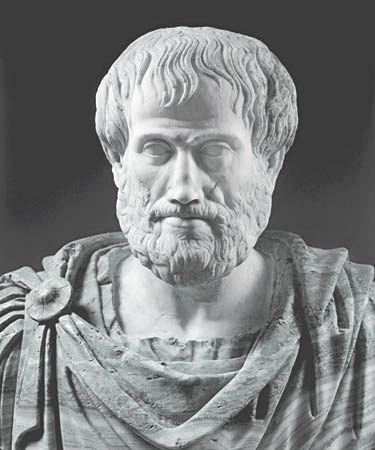
Aristotle
Aristotle briefly considered the possibility that the universe as we know it evolved by chance. He believed there are four essential causes involved in any natural change,(1) and also any number of accidental causes: chance and luck being two of them.(2) Chance is an accidental efficient cause for any natural agent, while luck involves the consciousness of choice - human choice.(3) Aristotle made a definite distinction between chance and luck. For example, consider you have been trying to locate a person who can help you with a certain problem, but you can't find them. You go to a party and meet the person. This would be considered good luck. At the same party you could bump into someone you do not like and do not wish to meet. In that case, you would feel you had bad luck. Luck is a two-fold occurrence: sometimes considered good, sometimes considered bad, depending on the circumstances.(4) But you could have just as easily said that you met your friend by chance. To Aristotle, luck and chance are closely linked; all incidents of luck "also an effect by chance, but not every effect by chance is an effect by luck." (5)
Chance, on the other hand, seems to involve inanimate objects like rocks and stones. Also animals, such as horses and cats, all of which have no volition.(6) For example, when the comets hit Jupiter, they had no choice in the matter. When a boulder falls over a cliff and kills two people walking by, it is obvious the boulder did not make a conscious choice to cause injury to anyone.(7) Chance was not an independent or fifth cause to Aristotle, but rather, a species of existing cause such as efficient ones. Chance is an accident occurring only occasionally(8) and can be considered an indefinite possibility in natural occurrences. For instance, if you go to a shopping centre to buy clothes and meet a friend who is also there to shop, your meeting is one of chance. Although it happened by accident, it still involves two essential efficient causes crossing paths with one another, with a coincidental meeting a by-product. Any accidental efficient cause, such as chance, never occurs without an essential efficient cause, which is prior to it,(9) such as the desire to buy clothes.
Aristotle does not deny that the universe may have evolved by chance, but says "however true it may be that chance is the cause of the heavens, that intellect or nature is of necessity a prior cause of this whole universe,"(10) because "no accidental cause is prior to an essential cause."(11) Aristotle would not believe in 'Creation' as an explanation for the existence of the universe because that would involve the belief that it is possible to get something from nothing. Although Aristotle may have disagreed with many things Parmenides said, he did not refute the fact that something cannot come from nothing. But if God, for example, did not create the universe, then who or what did?
Aristotle believed the universe was always here and did not come into existence. Nature always existed, nor will it go out of being. Nature, or the entire system of existence, exists independently of us and is a given. Human beings have a hard time assimilating that things exist apart from themselves and insist that a superhuman or a deity be given credit for everything that ever was. Some people believe that the universe must be without a beginning in time, owing no credit and acting with spontaneity, as can be seen when volcanoes erupt or floods wipe out entire towns.
So to Aristotle, the universe is eternal, even though he was convinced an "intellect or nature"(12) may have caused its evolution. Perhaps it did evolve by chance, since chance is always a possibility in any natural change,(13) but he does consider chance evolution to be an unsatisfactory explanation of how the universe unfolded.(14) There still must be something that acted as a prior cause, something of intelligence or maybe a natural force. Aristotle does not choose one or the other.(15) To him, evolution came to be "for the sake of something else."(16) It seems as if he was saying the universe is the final cause of "thought or of nature,"(17) with nature or intellect being the essential efficient cause. He does say "there is, then, final cause in things which come to be or exist by nature."(18)
It would be difficult not to accept Aristotle's Doctrine of the Four Essential Causes and his premise that there also exists accidental efficient causes, such as luck and chance. It all seems so clear and distinct, but what about his contention that chance evolution is an unsatisfactory explanation of how the universe evolved? It stands to reason that if one agrees with Aristotle on the other points, then one should also endorse him on the question of whether it is a satisfactory explanation. But he does nothing to dispel the dissatisfaction, besides saying that there must be a prior cause by way of an intellect or by nature. Why wouldn't he at least choose one or the other, especially since they are such radically different explanations. I can understand why he didn't make a scientific hypothesis on the nature of chance because it is such a random thing, but one can only wonder what he really thought about the universe's development. With the deductive and methodological mind he had, I expected him to stress that nature is the force that was the prior essential efficient cause. But is chance evolution such an unsatisfactory explanation?
Maybe not when you consider basic elements such as atoms and subatomic particles, and all the countless combinations of molecules, motions, and temperatures that could have gone into the emergence of life as we know it. Some yet undiscovered forms of energy could have played a role. Natural forces can act with a lot of spontaneity, depending on many different occurrences, resulting in many different outcomes. In his famous book, Human Adaptability, Emilio F. Moran wrote:
Evolution includes what may be termed mechanisms of continuity and mechanisms of variation. Mechanisms of continuity provide stability in nature, while mechanisms of variation are the products of chance and provide the variability in species that allows new solutions to be available when environmental changes occur.(19)
Moran also says that "it is easy to misunderstand that Darwin's view of evolution is not a product of chance. Quite the contrary. It is directional and in due time leads to adaptive solutions in nature."(20)
So it seems a very complicated question. Evolution may be considered a process of chance, but there also seems to be a fundamental direction, which may not come from any intellect, but from nature itself. Nature must be the life force that gave the universe its characteristics and chance is an accidental cause of the changes that occurred, playing a part in the process. Nature is a constant which can be seen in the eternal and consistent way celestial bodies move.
If Aristotle did write anything further on the subject, it has sadly not come down through the ages to us. The books he wrote were either lost or destroyed. What has come down to us are basically the lecture notes he created for his students. He did briefly consider the possibility that the universe as we know it evolved by chance; (21) however, only briefly, since agreement would have destroyed his Doctrine of Four Essential Causes - there had to be a prior essential cause for the change, as there was for "many other things and of this whole universe."(22) Aristotle does not deny that the universe evolved by chance because he could never prove it one way or the other. Ultimately, he thought it was a poor explanation. For him, there was something else in the background, some sort of design which gave direction and caused the universe to unfold. It may have been mind or nature.
On the surface, it seems that chance evolution is a satisfactory explanation, but is it really? I must agree with Aristotle and say it really is not good enough. Yes, chance plays an important role in the natural process of development, but it is not the whole explanation. There must be an underlying cause and I believe it is Mother Nature - a force that is outside the power of our volition and independent of any consciousness. Mother Nature exists independently of us and will still be here when we are gone. Mother Nature is a powerful force we can witness everyday in our own lives. Doesn't it make sense that it is the underlying essential cause of change since nature is something that can move us, leave us in a state of awe, and is something we yearn to be close to, like a baby to its mother? Who has not wanted to leave the concrete city and experience nature, taking in all its marvels, and rejoicing in the way it makes us feel? Mother Nature is the essential efficient cause of the changes that have occurred, while the outcome, the universe as we know it, is its final cause.
Related Papers
Hellenistic World: Alexander the Great and the Spread of Greco-Macedonian Culture